
NEDA: NEutron Detector Array for Nuclear Spectroscopy Studies


Introduction
In the quest to understand the fundamental properties of atomic nuclei, scientists rely on advanced detection systems to observe the particles emitted during nuclear reactions. Among these particles, neutrons play a crucial role, particularly in reactions involving neutron-rich or neutron-deficient nuclei. However, detecting neutrons with high efficiency and distinguishing them from gamma rays—a persistent challenge in nuclear spectroscopy—requires specialized instrumentation.
Here, it enters the NEutron Detector Array (NEDA), a state-of-the-art neutron detection system designed to work in tandem with high-resolution gamma-ray spectrometers like AGATA (Advanced Gamma Tracking Array). Developed through a large international collaboration, NEDA represents a significant leap forward in neutron detection technology, offering unparalleled efficiency, precision, and versatility for studying exotic nuclei and reaction mechanisms.
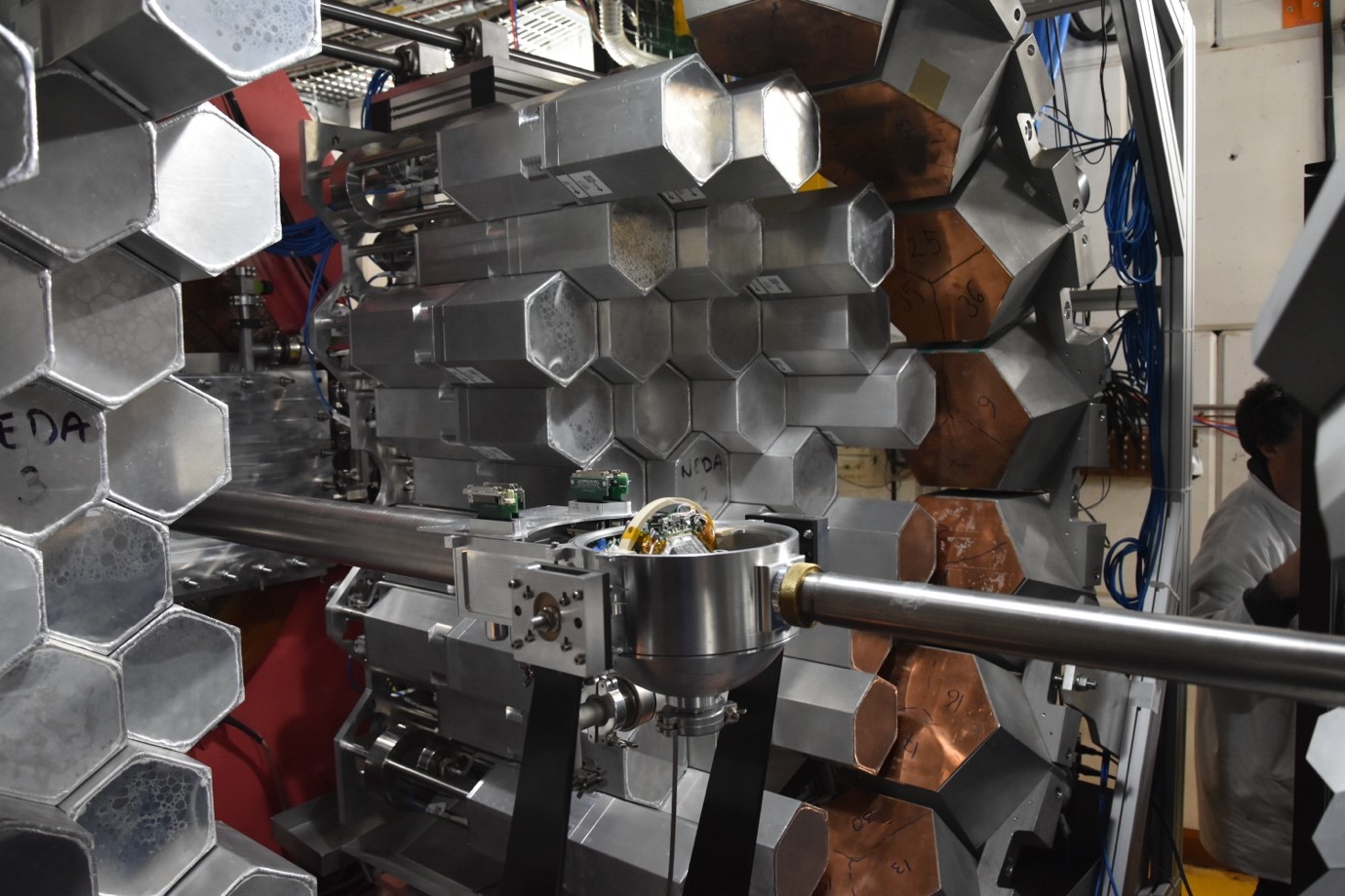
This picture shows the full NEDA array at the AGATA target position in its first implementation at GANIL.
The Design and Innovations Behind NEDA
1. Modular Hexagonal Detectors for Optimal Coverage
One of NEDA’s standout features is its modular hexagonal design. Unlike traditional square or cylindrical detectors, hexagonal units can tile a surface without gaps, maximizing active detection area while minimizing dead zones. Each detector consists of:
- A 146 mm side-to-side, 205 mm long aluminum cell filled with EJ301 liquid scintillator, a material known for its excellent light output and pulse-shape discrimination properties.
- A reflective inner coating (EJ520) to enhance light collection.
- A 5-inch Hamamatsu R11833-100 photomultiplier tube (PMT) selected for its superior timing resolution and a newly designed Voltage Divider by the collaboration to handle high counting rates without loosing energy resolution.
This design ensures high neutron-detection efficiency while maintaining excellent neutron-gamma discrimination—a critical requirement for cleanly separating signals from these two types of radiation.
2. High Efficiency for Diverse Reactions
NEDA’s performance has been rigorously tested through GEANT4 simulations, confirming its effectiveness in different experimental scenarios:
- Fusion-evaporation reactions: NEDA achieves a remarkable 40.5% efficiency for detecting single neutrons emitted in reactions like ⁵⁸Ni + ⁵⁶Fe.
- Transfer reactions: For high-energy neutrons (e.g., from ³He(¹⁸Ne,n)²⁰Mg), the efficiency remains substantial (~18.7%), making it ideal for studies involving radioactive beams.
The array can be configured in various geometries, providing flexibility for different experimental needs.
3. Advanced Pulse-Shape Discrimination and Timing
A major challenge in neutron detection is distinguishing neutrons from gamma rays, which often accompany them. NEDA tackles this using two key techniques:
- Pulse-Shape Discrimination (PSD): By analyzing the different decay times of scintillation light pulses produced by neutrons and gamma rays, NEDA can separate the two with high precision. The charge-comparison method yields a Figure of Merit (FOM) of ~1.7 at 320 keVee, indicating excellent separation.
- Time-of-Flight (ToF): Measuring the time delay between a neutron’s emission and detection further refines discrimination, especially for high-energy neutrons.
Artificial Neural Networks Pulse Shape discrimition has been also used and it significantly improve discrimination performance for both scintillators, achieving over 95% γ-ray suppression efficiency between 150–1000 keV electron-equivalent energy (Nuclear Inst. and Methods in Physics Research, A 916 (2019) 238–245).
These capabilities are enhanced by NEDA’s fully digital electronics, which allow for real-time signal processing and integration with gamma-ray tracking arrays like AGAT
Front-End Electronics
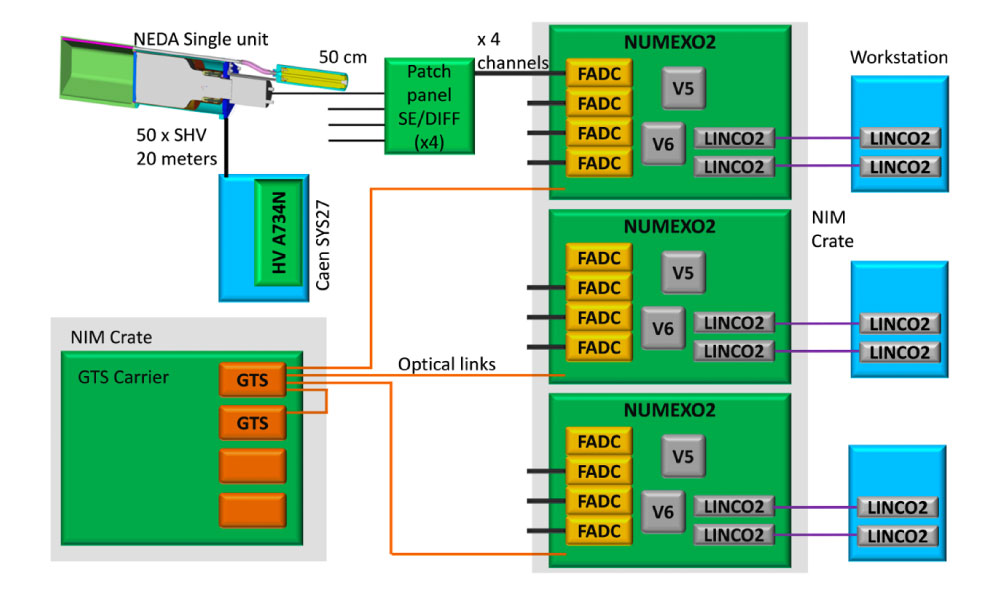
The front-end electronics for NEDA are designed to obtain precise timing and pulse-shape discrimination (PSD) necessary for efficient neutron-γ separation and time-of-flight (ToF) measurements. The system features a modular, high-performance design optimized for integration into complex experimental setups such as AGATA.
NUMEXO-2 is the dedicated digital front-end electronics module developed for the NEDA neutron detector array. It is designed to perform fast digitization, time stamping, and pulse-shape discrimination (PSD) with high precision, and to operate reliably in complex experimental environments such as those involving AGATA and DIAMANT.
Features of NUMEXO-2:
- Digitization:
- Each NUMEXO-2 board contains 4 channels, each digitizing the analog signal from a neutron detector at 250 MS/s with 14-bit resolution.
- The full waveform could stored for offline analysis, including advanced PSD methods.
- Pulse-Shape Discrimination (PSD):
- It implements charge integration algorithms (e.g., short gate vs. long gate) to distinguish between neutron and γ-ray interactions in real time.
- The board’s flexibility allows users to apply optimized PSD algorithms tailored to each experiment.
- Timing and Synchronization:
- Features constant-fraction discrimination (CFD) and time-to-digital conversion (TDC) to achieve sub-nanosecond time resolution.
- Fully integrated with the AGATA Global Trigger and Synchronization (GTS) system to ensure coherent time-stamping across multiple sub-detectors.
- Triggering and Data Handling:
- NUMEXO-2 can work in self-trigger mode or accept external triggers.
- It handles data buffering and readout efficiently to support high-rate environments.
- Scalability and Integration:
- Multiple NUMEXO-2 boards can be daisy-chained and controlled via a unified interface.
- Designed for seamless integration with AGATA, DIAMANT, and other detector systems used in nuclear spectroscopy experiments.
Probing the Limits of Nuclear Physics
NEDA’s versatility makes it indispensable for a wide range of nuclear physics experiments:
- Studying Exotic Nuclei Near the N=Z Line
Nuclei with equal numbers of protons and neutrons (N=Z) allow us to study, for example, the proton-neutron isoscalar and isovector pairing. The cross section to produce these nclei are very small and NEDA, coupled with AGATA, enables detailed spectroscopy of these nuclei by tagging neutrons emitted in fusion-evaporation reactions.
- Investigating Transfer Reactions
In reactions where a neutron is transferred between nuclei (e.g., (d,p) or (⁹Be,⁸Be)), NEDA’s limited angular resolution and efficiency allow physicists to reconstruct reaction kinematics and extract crucial information about nuclear structure and reaction mechanisms.
- Future Experiments with Radioactive Beams
Upcoming facilities like SPES (Italy), SPIRAL2 (France), FAIR (Germany), and HIE-ISOLDE (CERN) will produce intense beams of unstable nuclei. NEDA’s ability to operate in high-rate environments makes it a key tool for these next-generation experiments.
First Experimental campaign of NEDA
At the beginning of 2018 started the first physics campaign of NEDA+AGATA in GANIL. During 2018 five experiments were successfully performed for a total of more than 1000 h of beam on target.
The experiments performed with the setup NEDA+AGATA+DIAMANT were:
- A. Boso: Isospin symmetry breaking and shape coexistence in mirror nuclei 71Kr – 71Br.
- B. Cederwall: Search for isoscalar pairing in 88Ru.
- S. Lenzi: Effects of Isospin Symmetry Breaking in the A=63 mirror nuclei.
- J. Nyberg, M. Palacz, et al.: Studies of excited states in 102,103Sn to deduce two-body neutron interactions, single-particle energies and N = Z = 50 core excitations.
- A. Gadea, J.J. Valiente Dobon, E. Clément, et al.: Shell evolution of neutron-deficient Xe isotopes: Octupole and Quadrupole Correlations above 100Sn.
In the following, we present a representative example of the physics addressed during this campaign, as described in the article “Isospin Properties of Nuclear Pair Correlations from the Level Structure of the Self-Conjugate Nucleus ⁸⁸Ru” PRL 124, 062501 (2020), that investigates neutron-proton (np) pairing correlations, particularly the isoscalar (T=0) type, in the self-conjugate (N=Z) nucleus ⁸⁸Ru. Using an advanced experimental setup combining AGATA, NEDA, the Neutron Wall, and DIAMANT at GANIL, we populated excited states in ⁸⁸Ru via the ²⁴Fe(³⁶Ar, 2n)⁸⁸Ru reaction. Their gamma-ray spectroscopy measurements extended the level scheme of ⁸⁸Ru to higher angular momentum.
A key result is the delayed band crossing in the ground-state rotational band compared to neighboring N>Z isotones, interpreted as a signature of strong isoscalar np pairing. This delay is inconsistent with predictions based solely on isovector pairing and aligns with theoretical expectations for isoscalar condensate formation in heavier N=Z nuclei. The findings provide one of the most compelling experimental indications so far for the presence of isoscalar np pairing correlations in atomic nuclei.
Among other papers: PHYSICAL REVIEW LETTERS 124, 062501 (2020), PHYSICAL REVIEW C 104, L021302 (2021), PHYSICAL REVIEW C 106, 034304 (2022).
Further Reading
- Jaworski et al. Nuclear Instruments and Methods in Physics Research A 673 (2012) 64–72
- F.J. Egea, et al., IEEE TRANSACTIONS ON NUCLEAR SCIENCE, VOL. 60, NO. 5, OCTOBER 2013
- L. Luo Nuclear Inst. and Methods in Physics Research, A, 767 (2014) 83-91
- Modamio et al. Nuclear Instruments and Methods in Physics Research A 775 (2015) 71–76
- F.J. Egea et al., IEEE TRANSACTIONS ON NUCLEAR SCIENCE, VOL. 62, NO. 3, JUNE 2015
- Huyuk et al., Eur. Phys. J. A (2016) 52: 5L. Luo Nuclear Inst. and Methods in Physics Research, A, 897 (2018) 59-65.
- J.J. Valiente-Dobon et al., Nuclear Inst. and Methods in Physics Research, A 927 (2019) 81–86
Funding
The activities and contribution of the IFIC group to NEDA has been funded by the following grants:
- PROMETEO CIPROM/2022/54, Generalitat Valenciana, Spain, and by the EU FEDER funds
- PROMETEO/2019/005, Generalitat Valenciana, Spain, and by the EU
FEDER funds - PROMETEOII/2014/019, Generalitat Valenciana, Spain, and by the EU
FEDER funds - PROMETEO/2010/101, Generalitat Valenciana, Spain, and by the EU
FEDER funds