
CIPROM/2022/54
Development of advanced nuclear instrumentation for AGATA and its complementary detectors. Applications on medical physics and Compton imaging
Ref: PROMETEO CIPROM/2022/54 Generalitat Valenciana


The Project
The state-of-the-art in high-resolution gamma-ray spectrometer in Europe is represented by the Advanced GAmma Tracking Array (AGATA). AGATA aims to allow precision measurements in nuclear structure using high-resolution spectroscopy techniques. AGATA relies on the concept of gamma-ray tracking that requires large-volume HP-Ge detectors, with segmented contacts, as well as spectroscopic quality sampling electronics. The position sensitivity required for the gamma-ray tracking is achieved by performing Pulse Shape Analysis, of the charge and induced detectors signals, sampled with the digital electronics. AGATA is a moving instrument to be used in the nuclear research facilities operating presently in Europe and will be especially important for the experimental conditions expected at the future facilities for intense radioactive ion beams as well as for high-intensity stable ion beams.
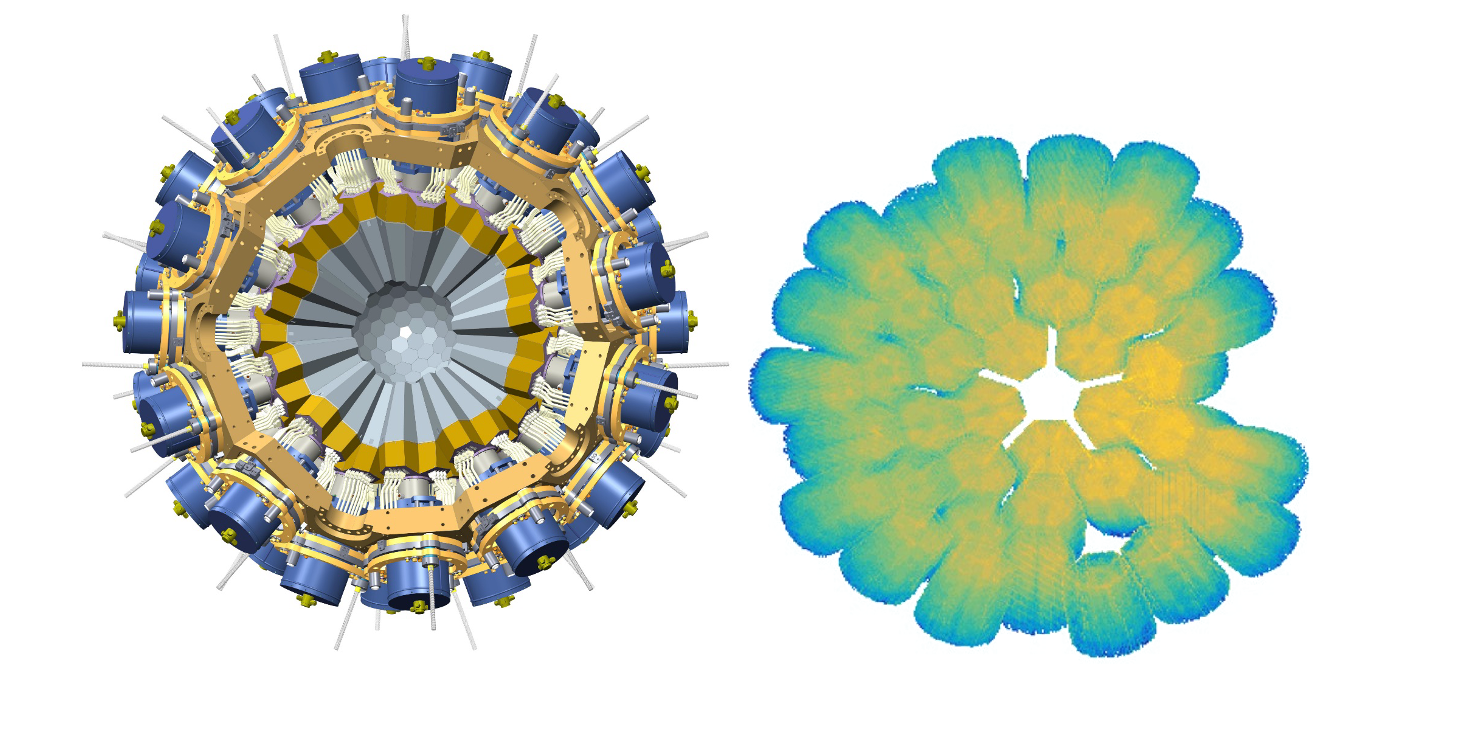
Nevertheless, advanced nuclear research cannot rely only on the detection capabilities of AGATA, the investigation of nuclear structure far from stability requires the use of complementary instrumentation that serves as trigger and supports the identification of the species or phenomena of interest.
Previous PROMETEO grants from the Generalitat Valenciana, have allowed our group to contribute to the instrumental R&D associated to AGATA and its complementary detectors, as NEDA, creating a know-how background in instrumentation at international level.
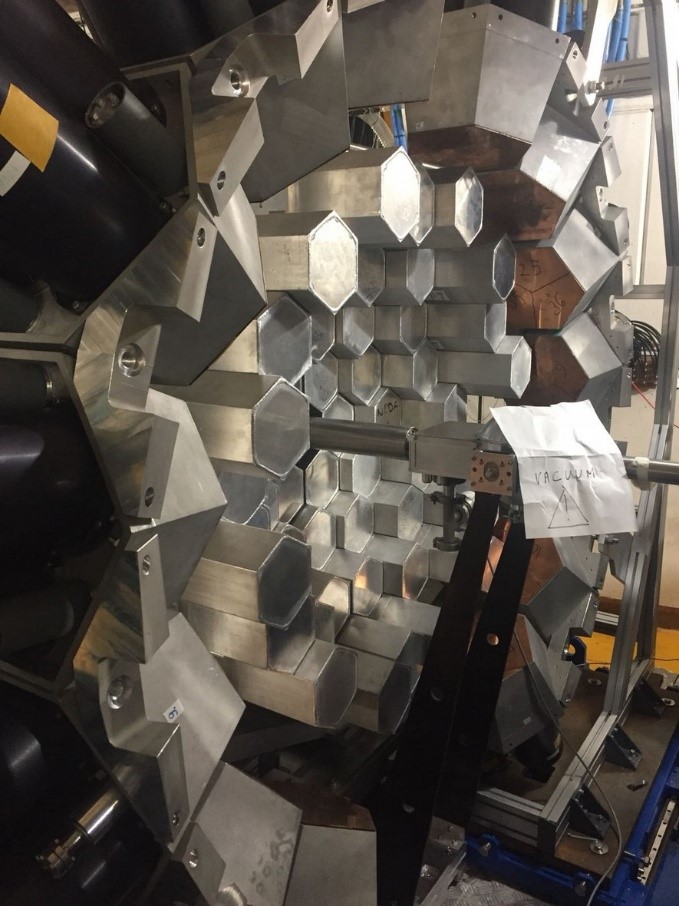
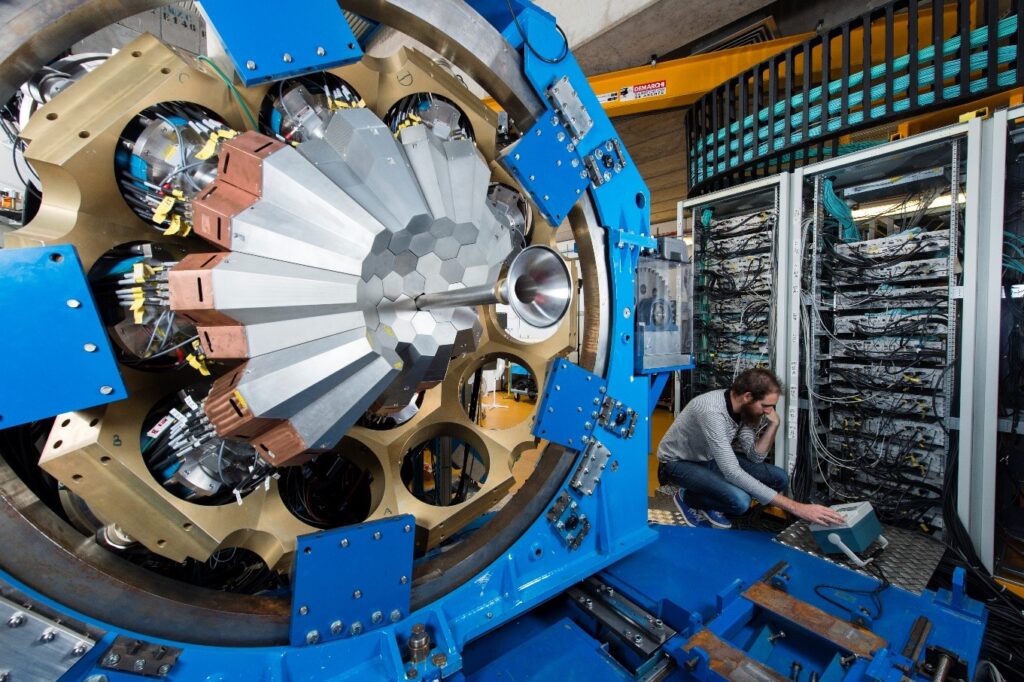
Early implementations of NEDA (left) and AGATA (right)
In the present project we intend to continue the contribution at the R&D in AGATA and its complementary instrumentation in the following aspects: firstly, on developments in the digitizer part of the concept of the Digital Pre-amplifier, that is in the basis of the conceptual design of the array but is still not achieved, second to continue with the R&D and construction of the complementary Neutron Detector Array (NEDA) to be coupled with AGATA in 2027. We also aim to continue our experimental activity on nuclear structure with AGATA coupled to complementary instrumentation.
In this occasion we propose as well to explore and possibly realize technology transfer, mainly for medical application. We will use the technologies developed for AGATA to instrument our prototype of position sensitive planar Ge detector, to be used as a development tool for high-resolution Compton imaging. We will also exploit the expertise gained during the development of electronics for this kind of experiments to develop instrumentation for radiotherapy to improve quality in this kind of treatments.
Scientific activity
Production of Neutron DEtector Array (NEDA) detectors
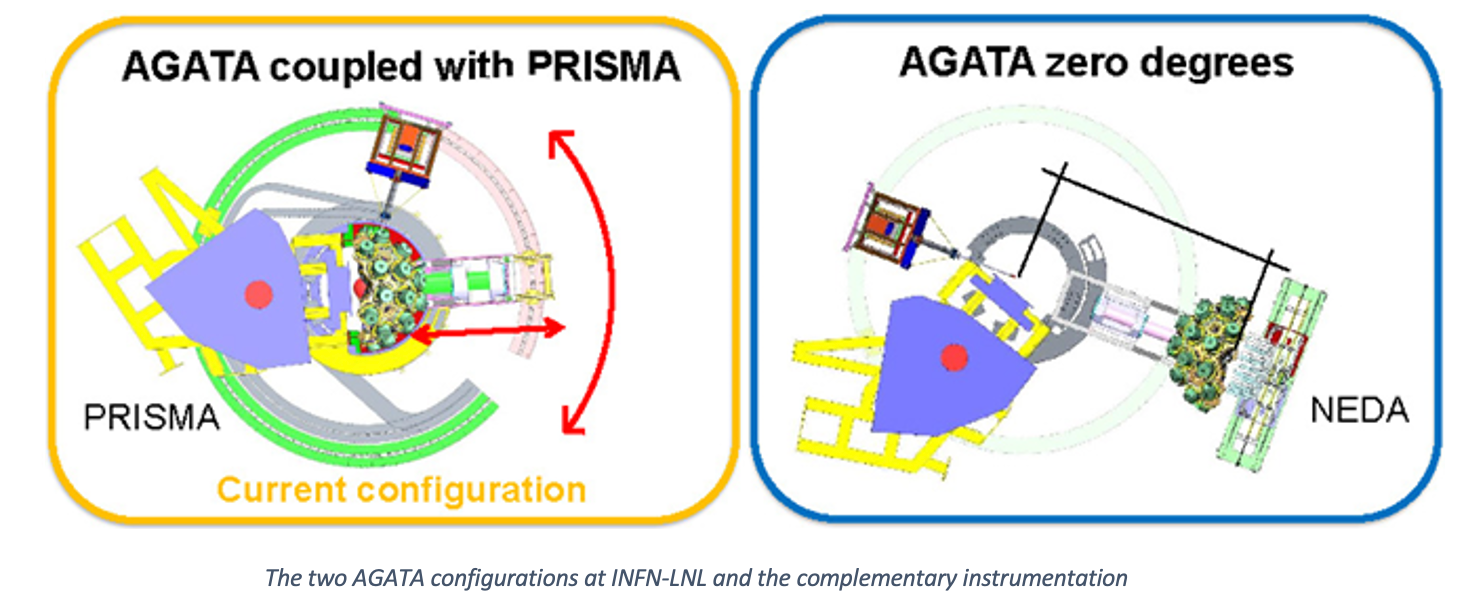
AGATA is currently installed at INFN-Laboratori Nazionali di Legnaro (INFN-LNL) in Italy, where two configurations are planned. The first is coupled to the PRISMA magnetic spectrometer and focuses mainly on experiments involving multinucleon transfer reactions (MNT) and fission. The second configuration, called “Zero Degree,” aims to experiment with stable high-intensity beams and radioactive beams with several complementary detectors, one of the most relevant being the NEDA neutron multidetector [1].
The transition between the two AGATA configurations is expected to take place at the end of 2026. One of the objectives of this project is to contribute, together with other members of the NEDA collaboration, to increasing the neutron efficiency and discrimination capability of NEDA. This contribution will take the form of the construction of new detectors.
AGATA Digital Preamplifier
The AGATA Digital Pre-amplifier project represents a significant advancement in signal processing and acquisition technology within the AGATA Triple Cluster cryostat. It encompasses a thorough research and development phase focusing on three main aspects: the development of analog cryogenic ASIC preamplifiers, the utilization of low-power sampling ADCs, and the redesigning of signal transmission systems.
Detector instrumentation developments for Compton imaging
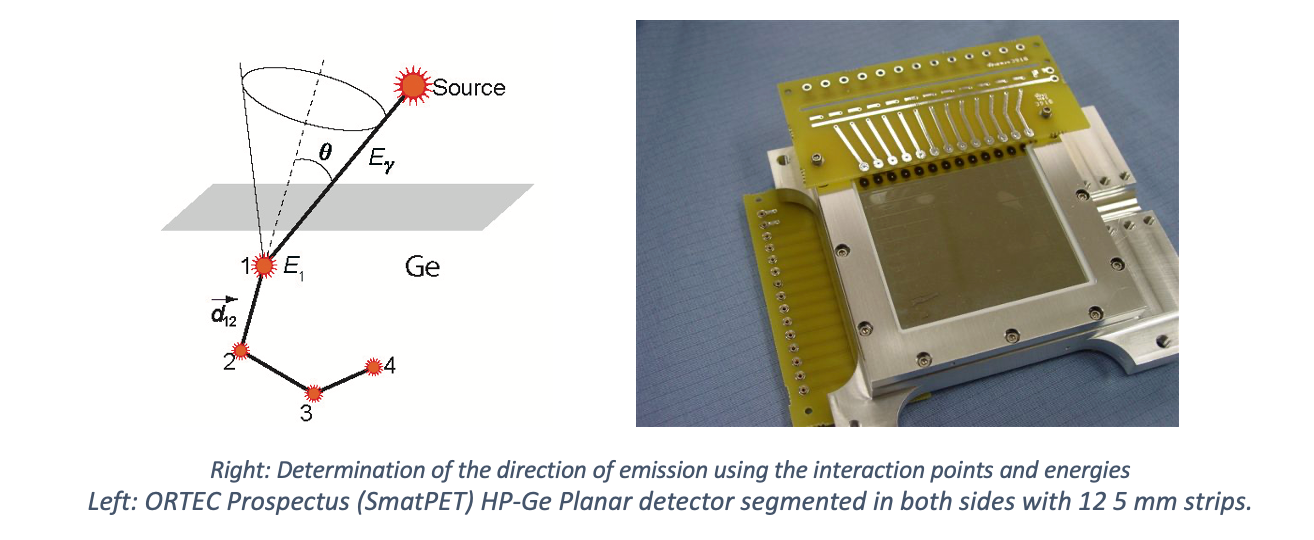
This research focuses on technological advancements in Compton Imaging and Medical Physics applications, leveraging previous expertise and collaborating with specialists in sensors, analog electronics, and instrumentation. The primary objective is to enhance knowledge and capabilities related to precise target or patient positioning in medical imaging. Several research groups within the AGATA collaboration, including those from the University of Liverpool, IPHC Strasbourg, KTH Stockholm, and GSI Darmstadt, have been investigating the use of planar strip HP-Ge detectors for Compton Imaging. The text mentions the procurement of a prototype SmatPET planar Double side strip HP-Ge detector, which is currently undergoing testing. However, further instrumentation and characterization are required for optimal performance.
[1] Valiente-Dobón, J. J., et al. “Conceptual design of the AGATA 2π array at LNL.” Nucl. Instrum. Methods Phys. Res.,A 1049 (2023) 168040. https://doi.org/10.1016/j.nima.2023.168040
Team
- Andrés Gadea Raga. Profesor de Investigación. IFIC, CSIC.
- José Javier Valiente Dobón. Profesor de Investigación. IFIC, CSIC.
- Vicente González Millán. Catedrático de universidad. ETSE, UVEG.
- Enrique Sanchis Peris. Catedrático de universidad. ETSE, UVEG.
- Profª. Silvia Casans Berga. Titular de universidad. ETSE, UVEG.
- Profª. Asunción Edith Navarro Antón. Titular de universidad. ETSE, UVEG.
- Ana Isabel Morales López, Investigador Doctor Contratado
- Rosa María Pérez Vidal, Investigador Doctor Contratado
- Laura Garrido Rey, Contrato pre-doctoral de formación PROMETEO
- Ruth Illicachi Guaman, Contrato pre-doctoral de formación PROMETEO
- José Blasco Miquel, Contrato de Personal Técnico de soporte PROMETEO
FUNDING
Project funded by Generalitat Valenciana
Project funded by Generalitat Valenciana, Spain, grant PROMETEO CIPROM/2022/54 and by the EU FEDER funds.